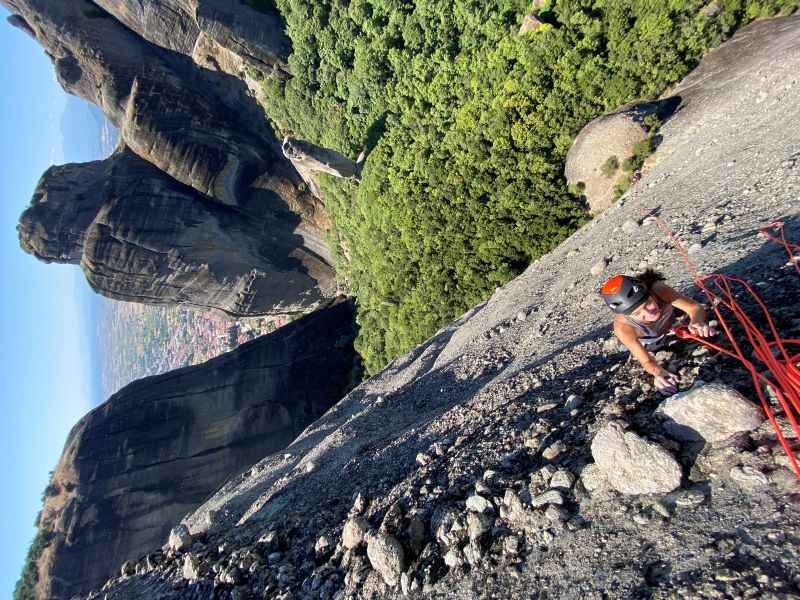
Slouched on the sofa lazily watching BBC’s Race Across The World my interest suddenly piqued with images of the racers wandering around the instantly identifiable towers of Meteora. Suddenly I was transfixed, a destination long established in my must-do list now reawakened.
I’d been pondering Greece for a family summer holiday, now the plan instantly solidified, the BBC cinematography had done its job well! A few months later we were there, the highlight of a three-week trip, though well accompanied I must add with many beautiful beaches, snorkelling, mind blowing fresh water rivers, hikes up mountains, scrambling, and copious amounts of wonderful food. A contender for perhaps my best ever summer holiday. But yes, Meteora really hit the spot. The kind of place a rock climber can really understand, not just an incredible place to observe (which it truly is), but one that can be fully explored, those towers climbed and enjoyed to the full. Sitting in the sun atop your chosen lump, with a 360 panoramic view is something really special.
For the rock climber perhaps we may feel we are given extra far above the chance to simply stare up into the dizzying heights. Indeed of the vast number of towers, all but a few are fair game, only the ones with monasteries are out of bounds. But that feels more than fair, in fact it feels an incredible privilege to be allowed to play; a testament to both the ongoing negotiations with the local authorities and the good nature of the climbers themselves, keeping a low profile, observing nature and leaving little trace. Big thanks indeed to the local climbers and outdoor enthusiasts.
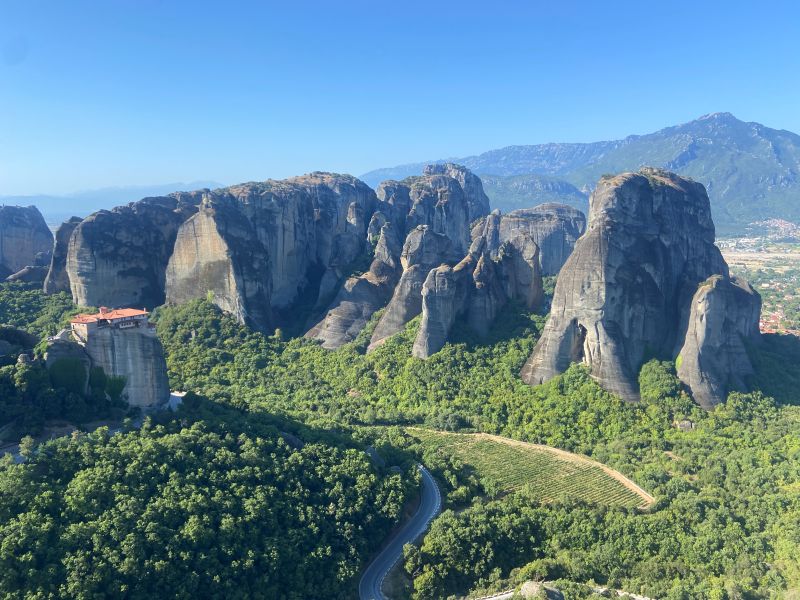
There is a pace about Meteora. It is relaxed and un-rushed. This is where you remember why you climb; grade pushing totally irrelevant. You’ve said ‘I love easy climbing too’ but this is the next level of ‘all-about-the journey’. Those towers are a day out, inching up, feeling the texture of those cobbles, hunting for your next bolt, a comfy belay, soaking up the view, and maybe the sun. Chatting with friends, sharing pitches, a sip of water, and maybe a sandwich or two on the summit. From the lofty viewpoint observe all the monasteries, and the hordes of tourists far far away from your wonderful spot that seems so soaked in nature as to be almost overwhelming.
I’ve climbed 9b, onsighted 8b+, and E8. I target crags crammed with hard things, but here it was all about 6a’s, or even 5’s. 6b+ was hard enough, as its just not about hard, it’s about clambering, just enjoying. Though to be fair, the given grades do tend to be a little off, or even a lot off, with some long run-outs to say the least. Don’t even think about pushing your grade, it won’t end well. I’m not ashamed to admit I grabbed a quickdraw on a 7a, gripped by fear on those little stones, and unable to find anything good enough. It’s been a while since 7a was too hard!
And what of those little stones, or big ones, somehow glued into huge lumps. How much of each pebble is ‘in’ the rock, how is it really held in place and is it about to break away the moment you pull on it? Well, they seem remarkably attached, our team broke just one out of at least 50 pitches climbed between us. However, the advice for sure would be to stick to the classics, with well worn paths as ‘stable’ as they are ever going to be.
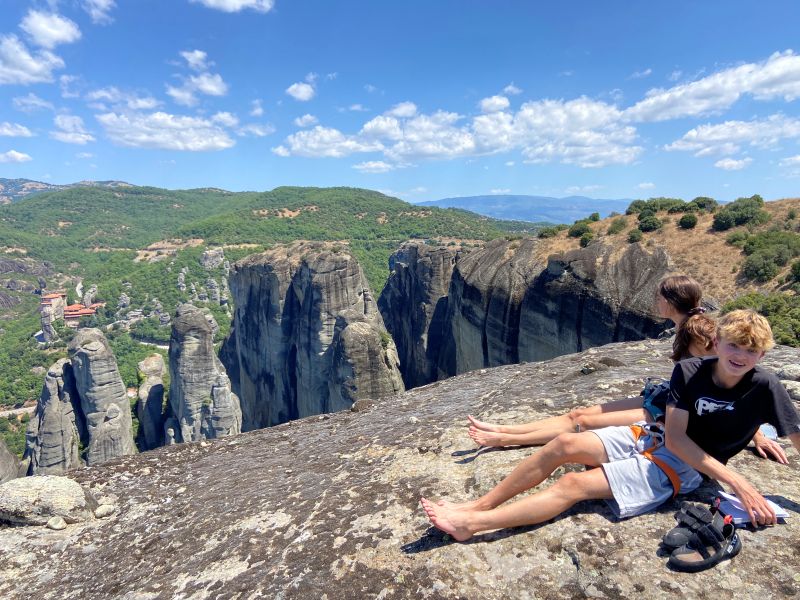
So what do you need to know? I guess when to go. August was just fine, and is probably as hot as it gets. Shade is easy to find, and the temps never excessive. Think just loving the fact that a T-shirt is gonna be all you need all day! Wonderful! Spring and Autumn may well be perfect. Winter could be pretty cold, though in the sun, most likely OK, it is Greece after all. Where to stay? There is Kastraki and Kalabaka. Check Google. Kastraki is by far the better option, with a beautiful quiet village vibe right in the middle of everything. All the climbing is within walking distance. Kalabaka is much busier. It will work as a base, but you just won’t get that chilled vibe. It does have plenty of supermarkets though including a great Lidl, well stocked with pastries for summit rewards. What to take. Standard sport rack, though often you won’t need all your draws! Connect-Adjust for belays. Abseil off is pretty much compulsory and never more than 40m in our experience (though sometimes actually 40m, so take care and have a knot in the end). An 80m sport rope is ideal. There are a few trad routes, and if you happen to have extra baggage space then maybe worth bringing, though often those routes need lots of big cams. We didn’t have any rack and never needed any, even when the description suggested a small rack could be useful.
Other stuff to do. Well of course there are many monasteries to visit, if that is your bag. Plus excellent walking around the area, or running if you fancy. River swimming is absent, the best we found being an hour away at the Stone bridge and waterfall of Palaiokarya. You also pass the fantastic crag of Pyli, which is steep tufa climbing at its very best.
Overall for most folk 5 days to a week will be enough, you will get a bunch of smaller routes in, a couple of big ones, a day trip somewhere else, a dose of walking, a few jogs and some lovely meals and chilling out. This is a truly remarkable place. Not one for your hardest redpoint project, but a place to be a true rock climber.